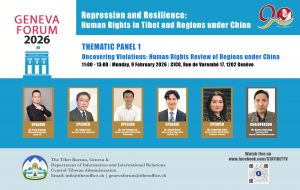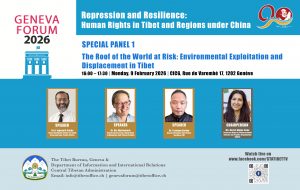
Examining State Narratives: Development and Dispossession
Introduction: Development as a Strategy of Legitimisation
Beijing’s official discourse on Tibet represents a calculated political project: the deliberate replacement of universal human dignity with state-led infrastructure as the primary measure of legitimacy. By elevating economic indicators, connectivity, and construction metrics above fundamental human rights, the Chinese government seeks not only to justify its decades-long rule in Tibet but also to reshape international norms around governance and accountability.
Framed through the language of “modernisation,” “poverty alleviation,” and “peaceful liberation,” state narratives present China’s presence in Tibet as both benevolent and historically necessary. Yet this veneer of progress obscures a violent history of occupation, systemic repression, and the denial of Tibetans’ political, cultural, and religious rights. Development, in this context, is not neutral—it is mobilized as a tool to normalize domination and silence scrutiny.
The panel deliberations challenge the premise that economic growth can excuse or compensate for the suspension of sovereignty, self- determination, and fundamental freedoms. Such a logic, if accepted, would establish a dangerous global precedent: that perceived underdevelopment constitutes a mandate for external control. The international community has consistently rejected this expansionist reasoning, recognizing that to do otherwise would undermine international stability and the rule-based order.
Colonial and Internal-Colonial Logics of Development
Development policies in Tibet and other regions under Chinese governance reflect what many scholars and human rights experts identify as internal colonialism. In this model, a dominant political centre asserts control over peripheral territories by restructuring economies, governing land and resources, and reshaping social and cultural life according to state-defined priorities.
Tibet is consistently portrayed in official discourse as incapable of self-directed progress— “backward,” “isolated,” or environmentally mismanaged—thereby justifying intrusive state intervention. This paternalistic framing mirrors classic colonial narratives in which local societies are rendered passive objects of development rather than active agents of their own futures.
Such narratives erase Tibetan political history, governance traditions, and reform efforts, replacing them with a singular state-authored storyline in which development flows unilaterally from Beijing to the plateau. Resistance to this model is reframed as irrational, separatist, or hostile to progress, enabling coercive governance to be justified as stability maintenance.
A Case for Tibetan Agency: Challenging Paternalistic Myth
The claim that Tibetans lack the capacity for self-driven development is not only inaccurate—it is a foundational myth used to legitimise domination. Historical records demonstrate that Tibetan leaders actively pursued reform and modernisation long before Chinese intervention. The 13th Dalai Lama, Thubten Gyatso, initiated sweeping institutional reforms in the early twentieth century, including the establishment of Tibet’s first postal system in 1913, the introduction of a modern currency, the founding of the first English- language school in 1923, and the construction of the first hydroelectric power station in 1924. These efforts reflected a conscious engagement with global modernity on Tibetan terms.
Similarly, the 14th Dalai Lama articulated a strong commitment to social and political reform prior to exile. In exile, this vision has been realised through the establishment of a democratic governance system, culminating in his voluntary devolvement of political authority in 2011 in favour of an elected leadership. This transition stands as powerful evidence of Tibetan capacity for democratic self- governance and institutional development.
The systematic exclusion of these histories from official discourse is itself a form of dispossession—one that denies Tibetans their political subjectivity and reinforces the colonial fiction that development can only occur through external control.
The Mirage of Progress: Infrastructure as Control
By 2026, state-led infrastructure development—extensive roads, railways, urban projects, and full power grid connectivity—is frequently presented as proof of progress. However, reports from 2025–2026 indicate that much of this infrastructure serves dual civilian–military purposes, facilitating troop deployment, population surveillance, and “securitization” of the plateau. Development thus functions as an architecture of control rather than empowerment. Material expansion has not increased Tibetan freedom or agency; instead, it deepens dependence on the state and consolidates Beijing’s strategic grip.
Urbanization, resettlement programs, environmental zoning, and educational policies further disrupt communities, severing ties to ancestral territories and traditional ways of life, while boarding schools and labor programs advance assimilationist objectives. Development becomes a form of social engineering, eroding cultural diversity in the name of progress.
International human rights law offers a counterweight to these colonial narratives, affirming that development must be participatory, non-discriminatory, and culturally respectful. Advocacy must challenge frameworks that normalize structural injustice, rejecting infrastructure-as-legitimacy narratives and centering affected communities’ voices. Despite extensive constraints, Tibetans continue to assert agency through cultural preservation, environmental stewardship, documentation, and international advocacy, contesting the state’s monopoly over development narratives. A fundamental shift is required: development should be defined by the people it is meant to serve, not as a tool for domination, and international actors must confront the colonial logics embedded in current models.
Selected References:
- UN Office of the High Commissioner for Human Rights (OHCHR), Human Rights Concerns in the People’s Republic of China
- UN Committee on Economic, Social and Cultural Rights (CESCR), Concluding Observations on China
- UN Committee on the Elimination of Discrimination against Women (CEDAW), Concluding Observations on China
- UN Special Rapporteur on Cultural Rights, Thematic Reports on Minority and Cultural Rights in China
- Human Rights Watch, China’s Forced Relocation of Rural Tibetans
- International Commission of Jurists, The Question of Tibet, and the Rule of Law
- Center for Strategic and International Studies, China’s gray-zone infrastructure strategy: Tibetan Plateau roads, dams, and digital domination